Choosing the Right Coin and Network for Your Crypto Swap
One of the most overlooked parts of making a crypto swap is the setup. Not the actual swapping, but the decisions you make before you hit confirm. Which coin pair to use, which network to send on, and whether there’s a smarter route than the obvious one. These choices affect your fees, your speed, and sometimes whether the swap works at all.
Picking Your Pair
If you know exactly what you want, say Bitcoin to Ethereum, the choice is made. But a lot of swaps aren’t that simple. Maybe you want to move from one altcoin to another, or convert something into a stablecoin, but aren’t sure which one.
The general rule is that major pairs have better rates. BTC, ETH, USDT, and other high-liquidity coins get tighter spreads because there’s more trading volume behind them. If you’re swapping between two smaller altcoins, you’ll often get a better deal by routing through a major coin in between.
For example, swapping Altcoin A for USDT first, then USDT for Altcoin B, sometimes yields a better total rate than a direct A-to-B swap. On a reputable non-KYC exchange, you can quickly check both paths and compare the estimated amounts to see which works out better.
Why the Network Matters More Than You Think
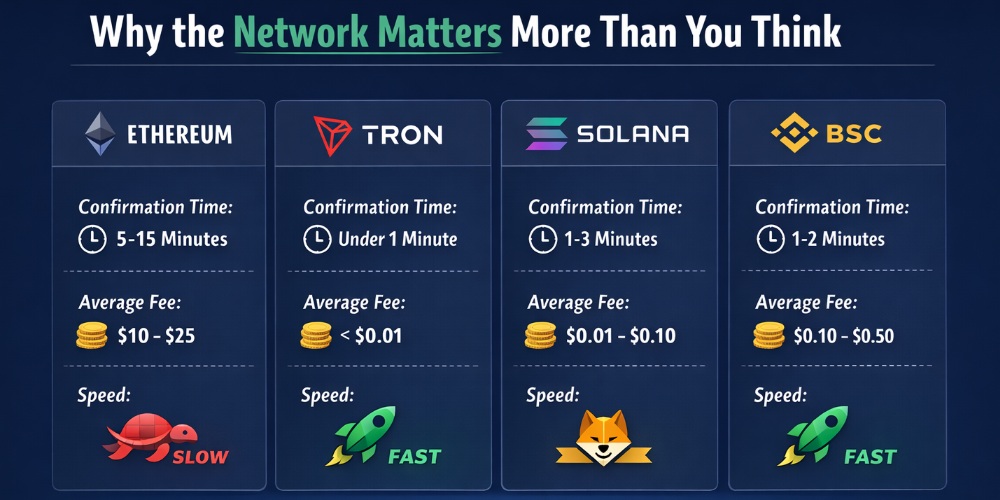
Here’s where people lose money without realising it. Many popular tokens exist on multiple blockchain networks. USDT runs on Ethereum, Tron, Solana, BSC, Polygon, and several others. The token is the same in value, but the network you choose affects three things.
- Transaction speed. Sending USDT on Tron takes a few seconds to confirm. On Ethereum, it could be minutes. On Bitcoin’s network (as a wrapped token), even longer.
- Network fees. This is the big one. A USDT transfer on Ethereum during a busy period can cost $10 to $25 in gas. The same transfer on Tron costs fractions of a cent. If you’re swapping $100 worth of crypto, a $20 network fee just wiped out 20% of your transaction. On a $5,000 swap, the same fee is negligible. Scale matters.
- Wallet compatibility. Your receiving wallet needs to support the specific network you’re receiving on. If your wallet only supports Ethereum-based tokens and you receive USDT on Tron, you won’t see the funds. Always verify that your receiving wallet handles the network you’ve selected.
The Stablecoin Decision
If you’re converting volatile crypto into something stable, you’re choosing between USDT, USDC, DAI, and a few others. For most swap purposes, USDT has the widest availability and deepest liquidity, which usually means tighter rates. USDC is a strong alternative, especially if you prefer a stablecoin with more transparent reserves. DAI is decentralised but less widely supported for direct swaps.
The practical advice is to pick whichever stablecoin is cheapest to receive on the network you’re using. If you’re on Tron, USDT is the obvious choice. If you’re on Ethereum and already have USDC infrastructure set up, stick with USDC. Don’t overthink it for routine swaps.
Common Mistakes With Pair and Network Selection
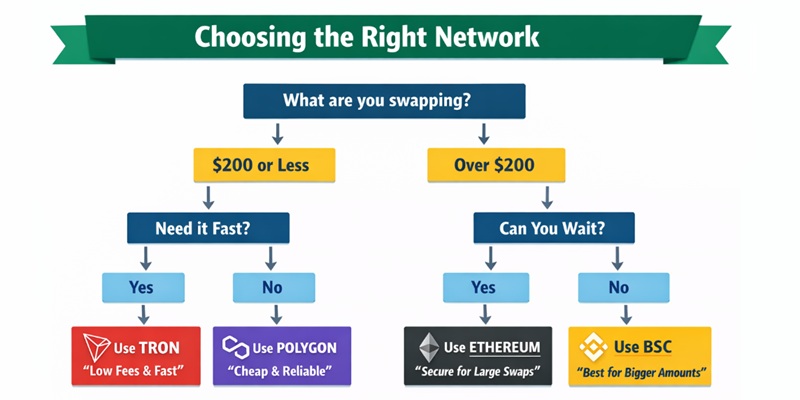
- Defaulting to Ethereum for everything. If you’re not specifically interacting with Ethereum-based DeFi or dApps, there’s often a cheaper network that handles the same token.
- Ignoring the receiving wallet’s network support. This is the most expensive mistake. Always confirm your wallet supports the receiving network before you start the swap.
- Choosing exotic pairs for small amounts. If you’re swapping $50 between two low-liquidity tokens, the spread might eat a noticeable chunk of your amount. Route through a major coin instead.
- Not checking fees relative to your swap size. A $5 network fee on a $5,000 swap is fine. The same fee on a $30 swap is brutal. Match your network choice to your transaction size.
Putting It Together
Before your next swap, spend 30 seconds thinking about the route. Is there a cheaper network for the token you’re using? Would routing through a stablecoin give you a better rate? Does your receiving wallet actually support the network you’re about to select?
These small decisions compound. If you’re swapping once a year, it doesn’t matter much. If you’re swapping regularly, choosing the right pair and network each time can save you hundreds of dollars per year in fees and spread costs more evenly. It’s the easiest optimisation most crypto users never bother with.